























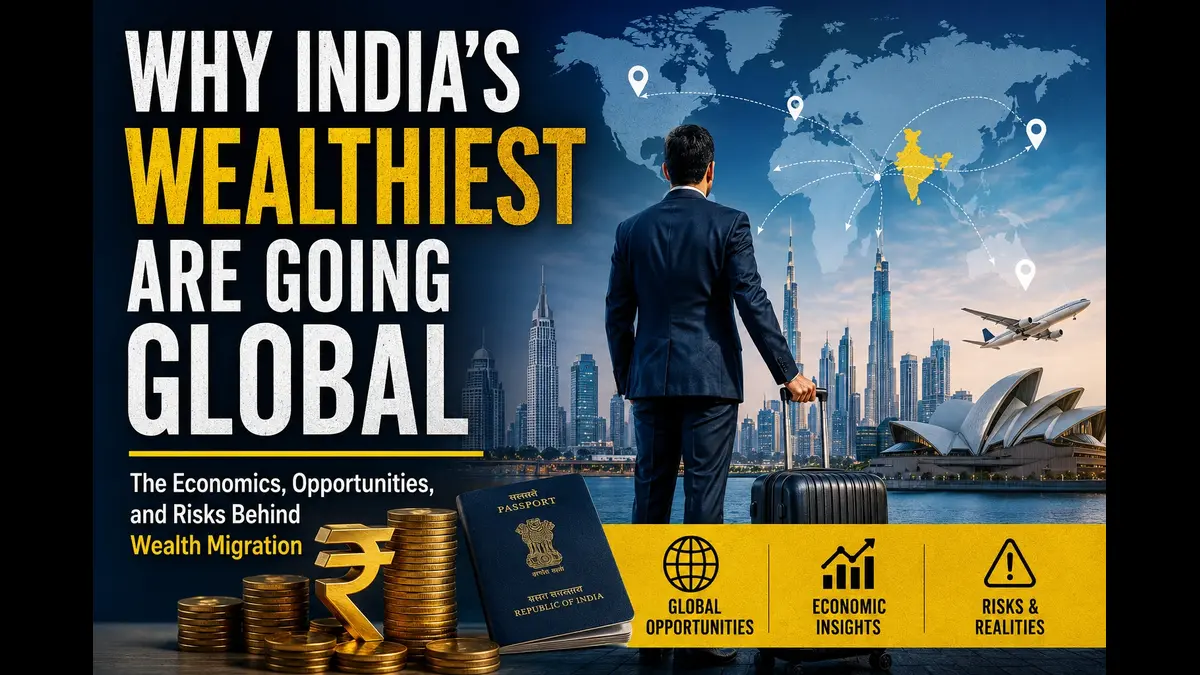
Why India’s Wealthiest Are Going Global
Discover why India’s wealthiest individuals are investing and relocating globally. Explore the economic drivers, investment opportunities, tax considerations, risks, and future outlook in this comprehensive 2026 guide.
Why India’s Wealthiest Are Going Global: The Economics, Opportunities, and Risks Behind Wealth Migration
Reading Time: 8–10 Minutes
Last Updated: June 21, 2026
Author: Editorial Team
Executive Summary
India is creating millionaires faster than almost every major economy. Simultaneously, an increasing number of affluent Indians are expanding their financial footprint beyond national borders. Contrary to popular perception, this trend is rarely about abandoning India. Instead, it reflects a sophisticated wealth management strategy focused on diversification, global asset access, education, business expansion, and long-term risk management.
This article examines the economic forces driving wealth migration, evaluates the opportunities available through international investments and residency programs, discusses regulatory considerations, and analyzes the associated risks using publicly available research and expert analysis.
Key Takeaways
- India continues to produce one of the world’s fastest-growing populations of millionaires.
- Wealth migration increasingly represents portfolio diversification rather than permanent relocation.
- International investments provide currency diversification, access to global innovation, and geographic risk reduction.
- Tax planning must comply with Indian regulations and international reporting standards.
- Global diversification introduces new legal, regulatory, currency, and geopolitical risks.
- Most wealth advisors recommend balancing domestic growth opportunities with carefully selected international exposure.
India’s Wealth Creation Story Is Accelerating
India has emerged as one of the world’s fastest-growing major economies over the past decade. Rapid digitalization, entrepreneurship, manufacturing expansion, financial market development, and startup innovation have significantly increased private wealth creation.
According to global wealth studies published by organizations such as UBS, Capgemini, and Henley & Partners, India continues to experience substantial growth in the number of High-Net-Worth Individuals (HNWIs).
This growing affluence has naturally increased demand for international diversification strategies.
Fact
Economic growth has expanded investment capacity among affluent Indians.
Analysis
Greater wealth typically leads investors to seek broader geographic diversification rather than concentrating assets within one economy.
Why Wealthy Indians Are Going Global
Several interconnected economic factors explain this trend.
1. Portfolio Diversification
Financial professionals generally discourage concentrating all investments within one country.
Diversifying internationally helps reduce exposure to:
- Domestic economic slowdowns
- Currency depreciation
- Political uncertainty
- Local market volatility
Global diversification follows one of investing’s oldest principles:
“Don’t put all your eggs in one basket.”
2. Access to Global Companies
Many of the world’s largest companies operate outside India.
International investing provides exposure to sectors including:
- Artificial Intelligence
- Biotechnology
- Semiconductor manufacturing
- Global healthcare
- Aerospace
- Cloud computing
These industries may be underrepresented in domestic markets.
3. Currency Diversification
Most affluent families measure wealth across generations rather than years.
Holding assets denominated in multiple currencies—including the US dollar, euro, Swiss franc, or Singapore dollar—may reduce dependence on any single currency.
Currency diversification can also support overseas education, business expansion, or international property purchases.
4. Education Planning
Many affluent Indian families have children studying abroad.
Maintaining foreign investments or overseas accounts may simplify:
- Tuition payments
- Living expenses
- Long-term financial planning
Education planning remains one of the strongest practical drivers of global financial exposure.
5. Business Expansion
Indian entrepreneurs increasingly operate internationally.
Global operations often require:
- Foreign bank accounts
- International subsidiaries
- Overseas investments
- Cross-border acquisitions
In such cases, international asset ownership becomes part of business strategy rather than personal migration.
Investment Opportunities Driving Global Wealth Migration
International investing offers access to a broader universe of assets.
Common options include:
Global Equities
Investors gain exposure to multinational corporations across technology, healthcare, consumer products, energy, and finance.
International ETFs
Exchange-Traded Funds allow diversified investment across countries, sectors, and themes with relatively lower costs.
Global Bonds
Fixed-income securities issued by governments and corporations can provide income diversification.
Real Estate
Prime residential and commercial property in selected global cities attracts investors seeking geographic diversification and rental income.
Venture Capital
Some wealthy investors allocate capital to international startups and private equity opportunities.
Family Offices
Ultra-high-net-worth families increasingly establish family offices that coordinate investments across multiple jurisdictions.
The Economics Behind Wealth Migration
Several macroeconomic factors explain why international diversification has become more attractive.
Rising Domestic Wealth
As disposable wealth increases, investors naturally seek broader investment opportunities.
Financial Market Globalization
Technology has made international investing significantly easier than it was two decades ago.
Liberalized Investment Frameworks
India’s regulatory framework permits eligible residents to invest overseas within prescribed limits under applicable regulations.
Global Mobility
Modern business leaders often operate across multiple countries.
Financial structures increasingly reflect international lifestyles.
Important Risks Investors Must Understand
Global diversification is not without challenges.
Currency Risk
Exchange rates fluctuate.
Foreign assets may lose value when converted back into Indian rupees even if their underlying price remains unchanged.
Regulatory Complexity
International investing requires compliance with:
- Indian tax laws
- Foreign reporting requirements
- Anti-money laundering regulations
- International financial disclosure rules
Professional legal and tax advice is often essential.
Political Risk
Government policies can change unexpectedly.
Tax rules, residency regulations, capital controls, or sanctions may affect investments.
Liquidity Risk
Certain overseas assets—particularly private investments and real estate—may be difficult to sell quickly.
Taxation
Owning foreign assets may create tax obligations in multiple jurisdictions.
Double taxation agreements can reduce—but not always eliminate—potential tax complexity.
Wealth Migration Does Not Necessarily Mean Leaving India
One of the biggest misconceptions is that wealth migration always means physical relocation.
In reality, many affluent Indians continue to:
- Live in India
- Operate Indian businesses
- Pay Indian taxes where applicable
- Invest both domestically and internationally
For these individuals, wealth migration refers more accurately to capital diversification than permanent migration.
India’s Long-Term Investment Outlook Remains Strong
Despite increasing international diversification, India continues to offer compelling investment opportunities.
Positive structural drivers include:
- Young demographics
- Rising consumption
- Infrastructure investment
- Manufacturing growth
- Expanding financial markets
- Digital economy leadership
Many wealth advisors advocate maintaining meaningful exposure to India while selectively investing abroad.
This balanced approach attempts to capture domestic growth while reducing concentration risk.
Future Outlook
Global wealth mobility is expected to increase over the coming decade.
Several long-term trends support this view:
- Digital investing platforms
- International entrepreneurship
- Remote work
- Global education
- Cross-border business
- Rising financial literacy
At the same time, governments worldwide are strengthening tax transparency and international reporting standards.
As a result, future wealth migration is likely to become more regulated, data-driven, and professionally managed.
Conclusion
India’s wealthiest individuals are increasingly adopting a global investment mindset. For many, international diversification is not a vote against India’s economy but a strategy to manage risk, access new markets, preserve purchasing power, and support multigenerational financial goals.
The most resilient portfolios are often those that balance domestic opportunities with carefully selected international assets while remaining fully compliant with applicable laws and tax regulations. Investors should distinguish between evidence-based financial planning and assumptions that overseas investing is inherently superior. The appropriate strategy depends on individual objectives, risk tolerance, regulatory obligations, and professional advice.
Frequently Asked Questions (FAQs)
1. What is wealth migration?
Wealth migration refers to the movement or diversification of financial assets across countries. It does not necessarily mean that an individual relocates permanently.
2. Why are wealthy Indians investing overseas?
Common reasons include portfolio diversification, access to global markets, education planning, business expansion, and currency diversification.
3. Is overseas investment legal for Indian residents?
Yes. Indian residents can invest overseas within the limits and conditions prescribed by applicable Indian regulations. Investors should ensure full regulatory compliance.
4. Does wealth migration mean people are leaving India?
Not always. Many affluent individuals continue to live and conduct business in India while maintaining diversified international investments.
5. What are the main risks of investing internationally?
Key risks include currency fluctuations, regulatory changes, taxation, political developments, liquidity constraints, and market volatility.
6. Which global asset classes attract wealthy Indian investors?
Popular options include international equities, ETFs, bonds, real estate, private equity, venture capital, and diversified global portfolios.
7. Can international investing reduce portfolio risk?
Diversification across countries and asset classes may reduce concentration risk, but it does not eliminate investment risk or guarantee positive returns.
8. Are there tax implications for foreign investments?
Yes. Foreign investments may create reporting and tax obligations in India and, in some cases, abroad. Professional tax advice is recommended.
9. Is India still an attractive destination for investment?
Many analysts believe India retains strong long-term growth potential due to favorable demographics, infrastructure development, digital transformation, and expanding capital markets.
10. Should investors move all their wealth overseas?
Most financial planners recommend diversification rather than concentration. The appropriate allocation depends on an investor’s goals, time horizon, risk appetite, and regulatory considerations.
Editorial Policy
This article is intended for educational and informational purposes only. It does not constitute investment, tax, legal, or financial advice. Readers should consult qualified professionals before making financial decisions.
Fact-Check Policy
This article is based on publicly available information from reputable institutions, including global wealth reports, economic research, and regulatory guidance available as of June 2026. Analytical opinions are clearly distinguished from factual statements, and no future investment performance is guaranteed.