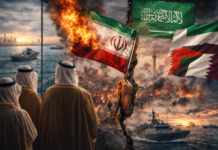






















The Calculated Silence: Why Arab States Watch Iran’s Turmoil Quietly
As protests unsettle Iran, its Arab neighbours choose restraint over rhetoric—guided less by sympathy for Tehran than by fear of what might come next.
When unrest flares in Iran, the quiet from across the Persian Gulf is striking.
There are no celebratory statements from Riyadh. No pointed condemnations from Abu Dhabi. No public encouragement for Iran’s protesters from the palaces of Doha or Kuwait City. In a region where words are often deployed as weapons, the silence of Arab states has become its own form of diplomacy.
This restraint is not indifference. Nor is it covert support for the Islamic Republic. It is something more complex—and more revealing: a calculated posture born of anxiety, experience, and a sober reading of Middle Eastern history. For many Arab governments, Iran’s instability is not a cause for open celebration but a strategic dilemma fraught with risk.
They may wish for a less aggressive Iran. But they fear a collapsing one even more.
A Neighbourhood That Knows the Cost of Collapse
Middle Eastern states have learned, often painfully, that regime collapse rarely delivers orderly transition. From Iraq to Syria, Libya to Yemen, the pattern is familiar: the fall of a central authority does not produce liberal democracy but power vacuums, militias, and protracted chaos.
Iran, with its population of more than 85 million and its dense web of ideological, sectarian, and security institutions, represents a far greater unknown.
For Arab leaders across the Gulf, the question is not whether the Islamic Republic has become brittle. That much is evident. The question is whether its potential fracture would produce a safer region—or an ungovernable one.
The prevailing judgment in most Gulf capitals is bleak.
The Gulf’s Paradox: Wanting Change, Fearing Consequences
Saudi Arabia and the United Arab Emirates sit at the centre of this calculation. Both have spent years pushing back against Iranian influence—from Yemen and Iraq to Lebanon and Syria. Yet neither has shown appetite for openly encouraging unrest inside Iran.
The reasons are strategic, not sentimental.
1. Economic Transformation Demands Stability
The Gulf today is not the Gulf of a decade ago. Its priorities have shifted from ideological confrontation to economic reinvention.
Saudi Arabia’s Vision 2030, the UAE’s post-oil diversification, and Qatar’s long-term investment strategy all depend on predictable regional conditions. Foreign capital does not flow easily into neighbourhoods on the brink of war. Investors are skittish. Tourism is fragile. Mega-projects are vulnerable to geopolitical shock.
A sudden collapse in Iran—especially one that triggers regional conflict—would threaten these ambitions overnight.
For Gulf leaders, economic stability has become synonymous with political survival.
2. The Iraq Precedent Looms Large
The spectre that haunts Arab capitals is not a strong Iran, but a fractured one.
The memory of Iraq after 2003 remains vivid: state collapse, sectarian bloodletting, empowered militias, foreign interventions, and years of instability that spilled across borders. Iran is larger, more complex, and more deeply embedded in the region than Iraq ever was.
A breakdown of authority in Tehran could unleash:
- Massive refugee flows into neighbouring states
- Armed factions competing for power
- Transnational militant movements exploiting chaos
- Disruption across vital energy corridors
For Gulf monarchies, the nightmare scenario is not a weakened Islamic Republic but an Iranian civil war with no clear end.
3. The Preference for Containment Over Collapse
What Gulf states ultimately seek is not Iran’s destruction but its domestication.
The ideal outcome, in their view, is an Iran that turns inward—abandoning revolutionary expansionism in favour of economic repair and diplomatic pragmatism. This is why Saudi Arabia restored diplomatic relations with Tehran in 2023 through Chinese mediation, even as mutual distrust remains deep.
Containment, not regime change, has become the default strategy.
Inside Iran: A System Under Strain
The Islamic Republic today faces pressures unlike any in its four-decade history. These pressures help explain both the persistence of protests and the anxiety they provoke abroad.
A Fractured Social Contract
Iran’s ruling compact—political control in exchange for economic security—has collapsed.
Sanctions, mismanagement, and corruption have hollowed out the economy. Inflation erodes wages. The currency has lost credibility. Subsidies that once cushioned the poor are increasingly unsustainable.
Unlike earlier protest waves driven by political reform, today’s unrest is rooted in exhaustion and despair. The grievances are material as much as ideological. This makes them harder to suppress—and harder to resolve.
A Weakened Regional Posture
Iran’s power projection—the so-called “Axis of Resistance”—is under strain.
- Hezbollah faces financial pressure and domestic backlash in Lebanon
- Iran-aligned militias in Iraq encounter growing nationalist resistance
- Syria’s conflict has drained resources and credibility
Ironically, this erosion may increase risk rather than reduce it. A regime that feels cornered can become unpredictable, opting for external confrontation to restore deterrence or rally domestic support.
The Absence of a Clear Alternative
Despite the scale of public anger, Iran’s opposition remains fragmented.
Exiled groups lack unity. Internal movements lack leadership structures capable of governing a post-Islamic Republic state. For outside observers, this absence of a credible transition plan deepens fears of a chaotic aftermath.
Arab states, having witnessed similar scenarios elsewhere, are unwilling to gamble on uncertainty.
The Global Dimension: A Fractured International Response
Iran’s crisis unfolds against a backdrop of competing international priorities, limiting coordinated action.
Europe’s Cautious Distance
European governments condemn repression but reject military intervention. Scarred by Libya and Iraq, they emphasise sanctions, diplomacy, and de-escalation.
Their overriding concern is preventing regional war—particularly one that could disrupt energy markets or trigger refugee flows toward Europe.
The U.S.–Israel Axis: Deterrence Without Escalation
Washington and Tel Aviv take a harder line, particularly on Iran’s nuclear programme.
Israel continues covert efforts to disrupt Iran’s military capabilities. The United States maintains a robust naval presence in the Gulf, focused less on internal Iranian politics than on preventing escalation.
The objective is deterrence, not regime collapse.
The Strait of Hormuz: The World’s Most Dangerous Bottleneck
Hovering over every calculation is the Strait of Hormuz.
Roughly one-fifth of global oil flows through this narrow passage. Any disruption would send shockwaves through global markets within hours.
Iran’s ability to threaten this chokepoint remains its most potent leverage. Even low-level harassment of shipping carries the risk of miscalculation and escalation.
For Arab exporters, whose economies depend on uninterrupted maritime trade, stability in the Strait is existential.
Silence, in this context, is a defensive measure.
Pragmatic Powers: China, Russia, and Turkey
Other regional and global actors further complicate the picture.
- China prioritises stability to protect energy imports and infrastructure investments.
- Russia values Iran as a tactical partner but has little interest in managing its collapse.
- Turkey fears refugee flows and regional fragmentation, pushing for diplomatic containment.
None favour dramatic upheaval.
Conclusion: Silence as Strategy
The quiet response of Arab states to Iran’s turmoil is not moral abdication. It is a form of strategic caution shaped by decades of regional trauma.
Their posture reflects a grim consensus: that an unstable Iran is dangerous, but a disintegrating one could be catastrophic.
For now, Arab capitals choose diplomacy over declaration, restraint over rhetoric. They watch, calculate, and hope that pressure leads to adjustment rather than explosion.
It is the silence of neighbours standing near a burning house—hoping the fire dies down, terrified of what might happen if it spreads.
FAQs
Why don’t Arab states openly support Iranian protesters?
Because they fear regional instability, refugee flows, and security vacuums more than they desire regime change.
Do Gulf states support the Iranian government?
No. Their silence reflects caution, not endorsement.
Could Iran’s instability trigger regional war?
Yes, particularly if it leads to miscalculation around the Strait of Hormuz or proxy conflicts.
Is diplomatic engagement replacing confrontation?
In many cases, yes. Gulf states increasingly favour containment over escalation.
What worries Arab leaders most about Iran’s future?
Not its ideology—but the consequences of its collapse.
Arab states are responding quietly to Iran’s unrest not out of sympathy, but fear. Their silence reflects concerns about regional instability, economic disruption, and the risks of state collapse, favouring containment over confrontation.
- How the Strait of Hormuz Shapes Global Energy Security
- Why Middle Eastern Regime Collapses Rarely End Quickly
- The New Diplomacy of Gulf–Iran Relations
Editorial note: This analysis reflects current geopolitical assessments and may evolve as events unfold.
Table of contents
Estimated reading time: 7 minutes