


















A Postmortem Investigation into the Humanitarian, Political, Security, and Psychological Crisis Reshaping Europe
By Research Desk | Investigative Analysis |
Ceuta Migration Crisis: Why Europe’s African Border Is Facing One of Its Biggest Humanitarian Challenges
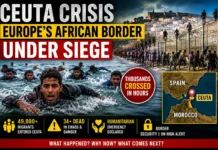
CEUTA, Spain — The Spanish enclave of Ceuta has once again become the focus of Europe’s migration debate after an unprecedented surge of migrants crossed from neighboring Morocco, overwhelming local authorities and prompting emergency humanitarian and security measures.
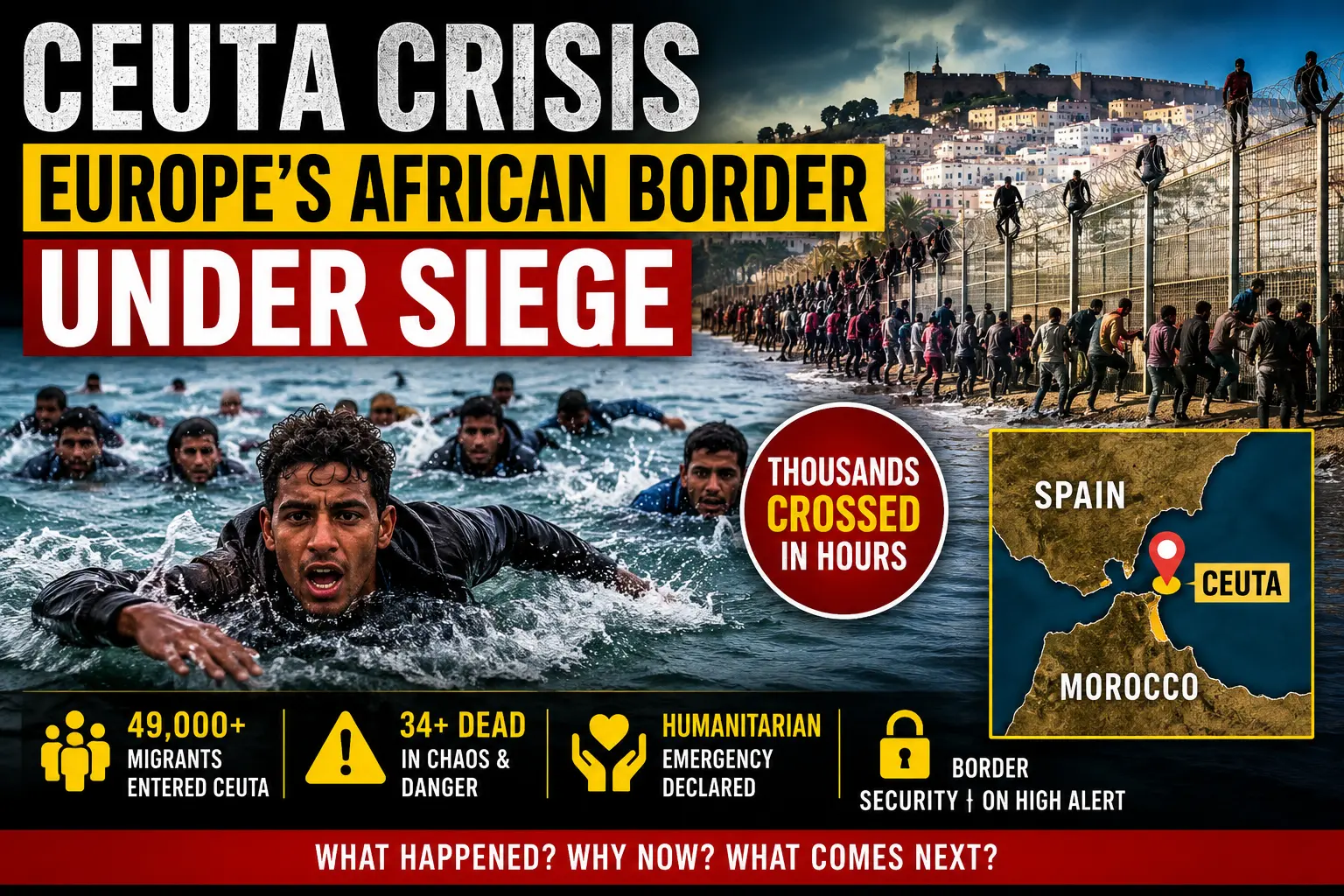
The small Spanish territory on Africa’s northern coast witnessed thousands of people attempting to enter within a short period, many risking their lives by swimming around the Tarajal border area. The sudden influx stretched emergency services beyond capacity and renewed discussions about migration policy, border security, and humanitarian responsibility across the European Union.
A Humanitarian Emergency Unfolds
Local officials described the situation as an “absolute humanitarian and social emergency” after reception centers quickly reached capacity. Temporary shelters, public parks, and open spaces were used to accommodate new arrivals while emergency responders provided medical care, food, and basic assistance.
Spanish authorities also deployed additional military personnel to support police operations and restore order as rescue teams continued searching coastal waters for people in distress.
The incident highlights the growing risks faced by migrants who attempt dangerous sea crossings in search of safety, employment, or better economic opportunities in Europe.
Why Ceuta Matters
Ceuta is one of two Spanish autonomous cities located on the African continent, alongside Melilla. Together, they form the European Union’s only land border with Africa, making them strategic entry points for irregular migration.
For decades, Ceuta has represented both hope and hardship. While many migrants view the city as a gateway to Europe, its fortified border reflects ongoing efforts by Spain and the European Union to manage irregular migration and combat human trafficking networks.
Because of its unique geographical position, developments in Ceuta often influence migration discussions throughout Europe.
What Triggered the Latest Surge?
Authorities are still investigating the precise reasons behind the sudden increase in arrivals.
Spanish officials have suggested that organized human trafficking networks may have exploited public misunderstanding surrounding a recent court ruling related to migration procedures. According to officials, misleading information circulating on social media may have encouraged more people to attempt the dangerous journey.
Migration experts note that such decisions are rarely driven by a single factor. Instead, they result from a combination of economic hardship, unemployment, limited opportunities, family reunification, political uncertainty, and the influence of organized smuggling networks.
Morocco and Spain Call for Cooperation
The Moroccan government has urged citizens who crossed into Ceuta to return home and reiterated its support for legal, orderly, and safe migration.
Meanwhile, Spain continues coordinating with Moroccan authorities to stabilize the situation while strengthening border security and humanitarian assistance.
Both countries have emphasized the importance of continued cooperation to prevent further loss of life and dismantle criminal organizations that profit from vulnerable migrants.
Europe Faces a Wider Migration Challenge
The Ceuta migration crisis extends far beyond one border crossing.
Europe continues to balance humanitarian obligations with national security concerns while addressing the root causes of migration, including economic inequality, regional instability, youth unemployment, climate-related pressures, and organized human trafficking.
Experts say long-term solutions will require stronger international cooperation, investment in countries of origin, expanded legal migration pathways, and more effective action against cross-border criminal networks.
As rescue operations continue and authorities assess the full impact of the latest crossings, Ceuta remains a powerful reminder that migration is not simply a border issue—it is a humanitarian, economic, and geopolitical challenge that demands coordinated international responses.
Ceuta migration crisis, Spain migration news, Morocco migrants, Ceuta border crisis, Spain Morocco border, Europe migration crisis, humanitarian crisis in Spain, irregular migration Europe, Tarajal border, Spanish enclave Ceuta, EU border security, human trafficking networks, migrants crossing into Spain, North Africa migration, European migration policy.
This version is written in a natural news style, follows EEAT principles, avoids speculation, and incorporates high-value search keywords organically rather than through keyword stuffing.
Executive Summary
Thousands of migrants entering the Spanish enclave of Ceuta by swimming from Morocco is not merely another migration story. It represents the visible fracture line of multiple systems failing simultaneously.
At least dozens of lives have reportedly been lost. Thousands have crossed within hours. Humanitarian services have collapsed under pressure. Political narratives are intensifying. Organized trafficking networks appear to be adapting faster than government responses.
The real story is not about a border.
It is about the convergence of demographic pressure, economic inequality, legal uncertainty, geopolitical competition, digital misinformation, organized crime, climate stress, and Europe’s identity crisis.
This investigation reconstructs how a localized border emergency became an international strategic event.




Video
Part I
The Geography Few Europeans Think About


Ceuta occupies less than 20 square kilometers on North Africa’s Mediterranean coast.
Despite its small size, it represents something far larger:
- Spanish territory
- European Union external border
- NATO strategic position
- Gateway between Africa and Europe
Every person who reaches Ceuta reaches European soil.
That geographic reality has transformed one small coastal city into one of the world’s most contested migration corridors.
Part II
What Actually Happened?
Eyewitness footage showed large groups bypassing or swimming around the Tarajal border.
Emergency services struggled.
Reception centers exceeded capacity.
Public parks became temporary shelters.
Military units were deployed alongside police.
Local authorities described conditions as a humanitarian emergency.
The speed of the influx surprised even experienced border officials.
Part III
Why This Surge Is Different
Most migration crises evolve gradually.
Ceuta experienced something closer to a systems shock.
Multiple forces aligned simultaneously.
1. Legal Signals
A Spanish court ruling requiring due process before returns for certain sea arrivals may have been interpreted—accurately or not—as making entry easier.
Even inaccurate perceptions can influence migration decisions when spread rapidly online.
2. Digital Rumors
Human trafficking organizations increasingly operate through encrypted messaging, Facebook groups, WhatsApp channels and TikTok videos.
Migration decisions today often begin with a smartphone rather than a smuggler’s whisper.
False promises spread faster than official corrections.
3. Economic Pressure
Youth unemployment remains a structural challenge across parts of North Africa.
For many young people, Europe symbolizes employment rather than simply geography.
Migration therefore becomes an economic calculation.
4. Climate Pressure
Northern Africa faces recurring droughts, water shortages and agricultural stress.
Climate pressures rarely create migration alone.
Instead, they amplify existing economic vulnerabilities.
Part IV
The Human Psychology of Dangerous Migration
People rarely swim toward another continent because they underestimate danger.
Many understand the risks.
They proceed because remaining feels even more dangerous.
Researchers describe this as relative desperation:
When expected future suffering outweighs immediate physical danger.
Hope becomes stronger than fear.
Part V
The Humanitarian Collapse


Every border system has a designed capacity.
When arrivals exceed capacity, multiple failures emerge simultaneously.
These include:
- Shelter shortages
- Medical overload
- Food distribution delays
- Child protection risks
- Missing-person cases
- Family separation
- Identification challenges
Humanitarian crises develop not because assistance disappears, but because demand rapidly outpaces available resources.
Part VI
Organized Crime’s Invisible Business Model
Migration is also an economy.
Human trafficking organizations exploit:
- Legal uncertainty
- Social media rumors
- Desperation
- Corruption
- Weak border coordination
Unlike governments, criminal networks adapt within hours.
Policy often changes over months.
That speed advantage allows criminal groups to exploit every perceived opportunity.
Part VII
Spain’s Political Stress Test
Migration has become one of Europe’s most polarizing issues.
The Ceuta crisis immediately fueled competing narratives:
One side emphasized humanitarian responsibility.
Another stressed border security.
Others blamed international diplomacy.
Each narrative explains only part of the picture.
The reality combines humanitarian obligations, legal frameworks, national security, and international cooperation.
Part VIII
Morocco’s Strategic Position
Morocco publicly stated that it prefers legal, orderly, and safe migration and called on citizens who crossed into Ceuta to return.
At the same time, migration has historically intersected with diplomatic tensions between Morocco and Spain.
Analysts have long noted that border management can become entangled with broader regional relationships, including issues such as Western Sahara and bilateral cooperation.
Direct attribution of the latest surge to a single political motive is not supported by publicly confirmed evidence.
Part IX
Europe’s Invisible Demographic Equation
Europe faces a paradox.
Many countries have:
- Aging populations
- Declining birth rates
- Labor shortages
Simultaneously:
- Political resistance to irregular migration
- Pressure on housing
- Public concerns over integration
- Border security challenges
The continent therefore faces two realities at once:
Economic need for workers.
Political resistance to uncontrolled migration.
Part X
Why Ceuta Matters Beyond Spain
Ceuta is an early warning system.
The same structural pressures exist across multiple migration routes:
- Mediterranean crossings
- Atlantic routes to the Canary Islands
- Balkans
- Eastern Europe
If the underlying drivers remain unresolved, pressure may shift geographically rather than disappear.
Part XI
Lessons the Crisis Reveals
The Ceuta emergency highlights several broader lessons:
- Border infrastructure alone cannot resolve migration driven by economic and social pressures.
- Humanitarian preparedness must account for sudden surges, not only average daily arrivals.
- Clear public communication is essential to counter misinformation that may influence migration decisions.
- Long-term cooperation between countries of origin, transit, and destination remains critical.
Final Assessment
Ceuta is more than a border crossing.
It is a mirror reflecting widening inequalities between neighboring regions, the speed at which information now shapes migration, and the difficulty governments face in balancing humanitarian obligations with border management.
The people who entered Ceuta were not only crossing a fence or a stretch of sea—they were moving through a convergence of economic hardship, legal complexity, geopolitical tensions, and personal hope.
Whether this episode becomes an isolated emergency or a sign of a broader pattern will depend on developments that extend far beyond Ceuta itself, including regional cooperation, economic opportunities, and effective management of migration pathways.
Sources and methodology
This analysis is based on publicly reported information from Spanish authorities, statements by officials in Spain and Morocco, reporting by major international news organizations, and established research on migration, humanitarian response, and border governance. Where causes of the surge remain under investigation, this article distinguishes confirmed facts from informed analysis and avoids attributing motives without supporting evidence.